

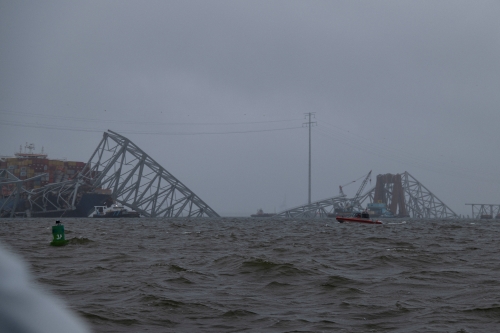
What The Key Bridge Collapse Reveals About a Nation Pushing 20th Century Bones Into 21st Century Loads
By Clay “Tiger” Hulin, photo from history.uscg
When the Francis Scott Key Bridge collapsed into the Patapsco River in March 2024, six men died and a major American port was paralyzed. Most folks remember the viral footage of the Dali losing power and drifting sideways like a wounded beast. But the latest NTSB finding cuts sharper than any video: a single wire, incorrectly labeled, prevented a full electrical connection and tripped the breaker that sent a thousand-foot ship drifting blind toward a pier.
One loose wire did not cause that collapse. A whole generation of drift did.
What happened in Baltimore was not chaos. It was not a butterfly effect. It was a predictable failure in a country still trusting infrastructure designed for a different world. And now the truth is rising to the surface: the loads we are placing on our bridges, ports, and roads in the 2020s are nothing like the loads they were built for. America is asking 20th century bones to survive 21st century weight. Below the waterline and above the asphalt, the strain is beginning to show.
The ships got bigger. The bridges did not.
When the Key Bridge opened in 1977, container ships were shorter, lighter, and slower. The Dali is nearly a thousand feet long, with more mass and momentum than any designer in the Carter era could have imagined. It hit a bridge never upgraded to face ships of the modern world. For decades, the protections around the piers were known to be inadequate. The risk was obvious. The fixes were not made.
That is the pattern. The world changes. The infrastructure does not. And eventually, the bill arrives.
The same problem is now driving over our bridges every day.

Bridge lovers did you see this John Kucko reporting from 2022 ?
While engineers were warning about vessel strikes and outdated pier protection, another crisis was rolling silently across America’s bridge decks. Electric vehicles are heavier than their gasoline counterparts. Not by a little. By a lot.
A typical EV weighs twenty five to fifty percent more than the same vehicle with an internal combustion engine. The F 150 Lightning weighs nearly seven thousand pounds. The Rivian R1T pushes past seven thousand. Electric buses can reach forty thousand pounds or more. And electric semi trucks, with their massive battery packs, consume much of the safety margin designed into older highway bridges before they even haul a single pound of cargo.
These bridges were built for sedans that weighed three thousand pounds, pickups that weighed four thousand, and buses that weighed twenty five thousand. Nobody in 1975 imagined city traffic where half the vehicles weighed five to seven thousand pounds and came loaded with instant torque off the line. Nobody imagined battery packs heavier than full engine blocks. Nobody imagined a stalled line of EVs idling on an interstate bridge in rush hour gridlock, every axle pounding a structure that was never meant to carry a fleet of rolling power plants.
This is not a political issue. It is a physics issue. Weight is weight. Stress is stress. A bridge does not care whether the power source is gasoline or lithium. It cares about load. And the load is rising every year.
The math is starting to bend.
Right now, more than forty thousand bridges in the United States are rated structurally deficient. Hundreds of thousands are past their original design life. Many of them have not seen a major structural upgrade since the Kennedy administration. Every year, the traffic gets heavier. Every year, the vehicles get heavier. Every year, the margin shrinks.
Engineers have a term for this problem. They call it load drift. It means the real world has quietly moved away from the assumptions used to design the structure. Ships grew. Trucks grew. Cars grew. Buses grew. The stresses grew. The bridges did not.
Load drift is the silent killer. It is the reason the Key Bridge fell. And it is the reason other collapses are coming if we keep pretending nothing has changed.

What it would take to fix this system?
Replacing or retrofitting every vulnerable bridge in America is not a five year job. It is not even a ten year job. A major bridge can take a decade from design to completion. The NTSB has identified at least sixty eight with vessel strike vulnerability, and the real number is far higher. We need more engineers, more welders, more deepwater construction crews, and more American manufacturing capacity than we currently possess. We need a national plan, not a patchwork of reactions.
And the truth is, we need courage. Real courage. The kind we used to have when this country built the Hoover Dam, the interstate system, and the Golden Gate Bridge. The courage to fix cracks before they widen, to strengthen structures before they fall, and to admit that a nation’s bones must keep pace with the weight placed upon them.
The lesson is simple. We ignore it at our own expense.
The Key Bridge did not fall because of a loose wire. It fell because we spent forty years telling ourselves we had time. We told ourselves the old designs were good enough. We told ourselves the next collapse could not possibly happen here. We told ourselves the world was not changing as fast as it was.
But ships grew. Vehicles grew. Loads grew. And now the bill is on the table.
APA Reference List (with links)
National Transportation Safety Board. (2025, November 18). Loose wire on containership Dali led to blackouts and contact with Baltimore’s Francis Scott Key Bridge.
https://www.ntsb.gov/news/press-releases/Pages/NR20251118.aspx
National Transportation Safety Board. (2024, May 14). Preliminary report: Contact of containership Dali with Francis Scott Key Bridge and subsequent bridge collapse (DCA24MM031).
https://www.ntsb.gov/investigations/Documents/DCA24MM031_PreliminaryReport%203.pdf
National Transportation Safety Board. (2025, March 20). NTSB urges evaluation of 68 U.S. bridges for vulnerability to vessel strikes.
https://www.ntsb.gov/news/press-releases/Pages/nr20250320.aspx
Parsons, J. (2025, November 18). Key Bridge rebuild cost rises to $5.2 billion; NTSB outlines collapse cause. Engineering News-Record.
https://www.enr.com/articles/61984-mdta-says-key-bridge-rebuild-could-cost-52b-as-ntsb-reveals-collapse-investigation-findings
Reuters. (2025, November 18). Loose wire caused power outage before ship crashed into Baltimore’s Key Bridge, NTSB says.
https://www.reuters.com/world/us/us-board-determine-cause-fatal-maryland-bridge-collapse-2025-11-18/
Maryland Matters. (2025, November 18). One loose wire caused ship blackout that toppled Maryland’s Key Bridge, NTSB says.
https://marylandmatters.org/2025/11/18/one-loose-wire-caused-ship-blackout-that-toppled-the-key-bridge-took-six-lives-ntsb-says/
The Washington Post. (2025, November 17). Investigators say Key Bridge collapse was preventable; rebuild cost balloons to $5.2B.
https://www.washingtonpost.com/dc-md-va/2025/11/17/key-bridge-cost-rebuilding-baltimore/
American Association of State Highway and Transportation Officials. (2009). Guide specification and commentary for vessel collision design of highway bridges (2nd ed.). AASHTO.
https://store.transportation.org/item/collectiondetail/176
Taleb, N. N. (2012). Antifragile: Things that gain from disorder. Random House.