Found almost anywhere in North America, this inedible mushroom was used to treat wounds by natural healers
Exploring the Western NY Wilds By Bob Confer, follow on Facebook
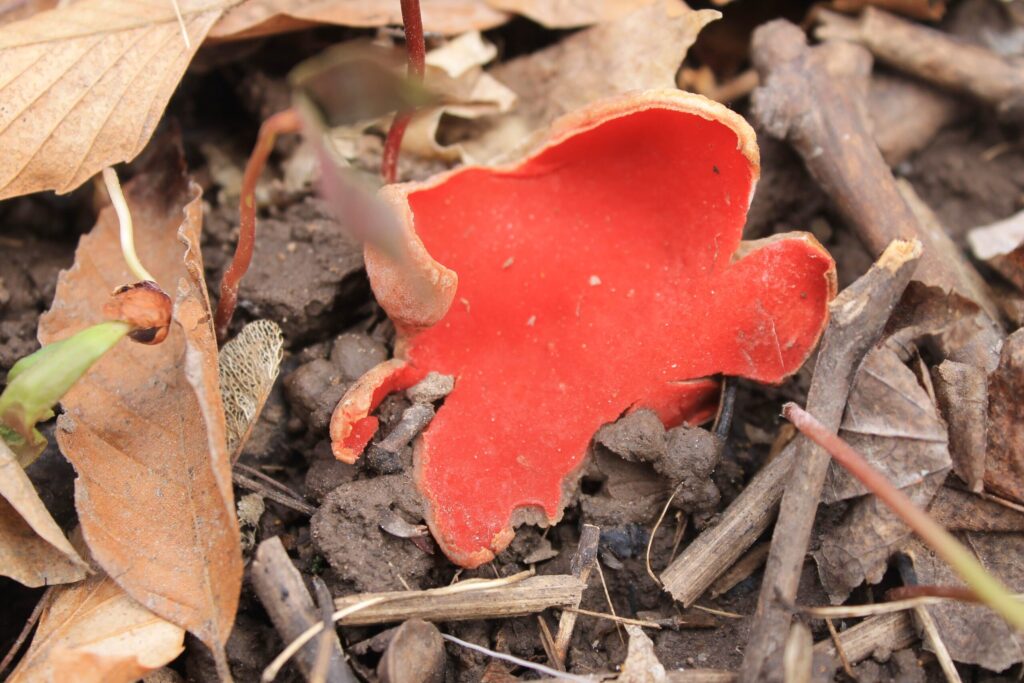
I’ll never forget the first time I saw a scarlet elf cup.
While hiking one March day some years ago, I noticed some red on the forest floor that caught my eye from some distance away. When walking in the woods during this month, which you could consider our “mud season”, one doesn’t expect to see a splash of color, especially with the beauty of the understory’s ephemeral flowers being weeks away.
So, I had to check it out. As I approached it, I thought it was a piece of plastic, maybe a chunk of a kid’s rubber ball. It was certainly bright enough. As I went to pick it up to properly dispose of it I stopped as I quickly realized it was not of Man’s creation, but of Nature’s – a brilliantly hued fungus.
The scarlet elf cup is unusual as its fruiting bodies appear in late-winter and early-spring. Most other mushrooms and fungi of brilliant appearance are seen during August and early-September. It is believed its color is so intense because that pigment protects the fungus from damaging UV rays, a necessity since it appears long before the protective canopy of the forest grows its leaves.

Not only is it eye-catching in color, it has decent size to it, too, being one half to two inches in width. It can be shaped like a flat dish or as a deep cup, hence the “cup” part of the name. As for the “elf” part of the nomenclature of this fungus — that can be found across the entire northern hemisphere — in European folklore it was believed wood elves drank morning dew from the cups.
It’s not too common, and you are more likely to see it in forests that have basswood trees, though they will also be found to a lesser degree in woodlands that have beech trees. It grows on rotting wood that has fallen to the ground. Although the visible fruiting bodies will be gone soon, the mycelium of the elf cup – its roots, if you will – are active all year long, consuming that wood. It is vitally important to the ecosystem as it decomposes the fallen limbs and puts the nutrients into the soil, which will be utilized by microorganisms, fungi, and plants.
The flesh of the fungus can be thick and rubbery, even elastic, which would make you believe that it actually is a piece of plastic. Because of that tough skin, and its general chemical makeup, depending on what book you read some say that it’s an inedible mushroom, while others say it is edible, but in moderation. When it comes to fungi, I almost always default to inedible — it’s safer.
While it may not be edible, that doesn’t mean it’s lacking in use. The Oneida saw it as a useful medicine. It was primarily used as a means to help newborn babies when it was placed on their navels to help with healing after severing of their umbilical cord. They also used it as a hemostatic agent, placing it under bandages to stop bleeding.
So, the next time you are in the woods and you see what looks like a piece of litter from afar, get closer and inspect it – it might be a scarlet elf cup, which is definitely not garbage and is an important treasure of the wild kingdom.
Bob Confer knows the WNY backwoods like the back of his hand. He shares his insights from a lifetime of exploring with our readers each week and can be contacted anytime, Bob@Conferplastics.com