
Lessons from New York’s Underground Railroad
From NYFocus.com,
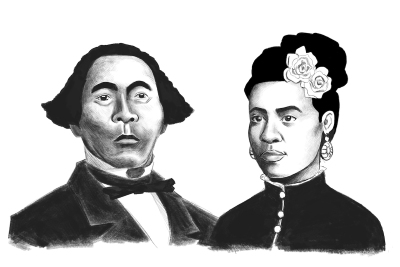
Pictured: Stephen and Hariet Myers by visual artist Marcus Anderson. The image of Stephen Myers is based on a photo of him in the autobiography of William Henry Johnson. The image of Harriet is an artist’s rendering of her informed by her obituary and a letter she wrote to William Jay in 1860. | Courtesy of the Underground Railroad Education Center
New York Focus talks with Paul and Mary Liz Stewart of the Underground Railroad Education Center in Albany.
When Paul and Mary Liz Stewart began researching the history of the underground railroad in New York more than two decades ago, they thought it would be simple to uncover the stories of freedom seekers who made their way through Albany.
“We thought wrong,” Mary Liz said. “Locating info about local folks was the challenge. We were coming up empty handed.”
Through the support of local librarians and academic researchers, the couple has dug through treasure troves of microfilm and archives scattered across the country to trace the journeys of people who escaped slavery and found freedom in New York.
The Underground Railroad Education Center is based at the Stephen and Harriet Myers Residence — a key site for the Underground Railroad in the state. The education center offers tours at the historic site while it preserves and restores the home where the Myerses once lived and supported others escaping slavery.
Earlier this year, the center faced a setback when the Trump administration moved to withhold a $250,000 grant it was set to receive via the National Endowment for the Humanities. The founders of the center have filed a lawsuit against the administration seeking to reinstate the grant.
For Paul and Mary Liz, the administration’s decision underscored the importance of their work in today’s political climate. We spoke with them earlier this week and are sharing an excerpt of the conversation in recognition of Juneteenth. The transcript has been edited for length and clarity.
— Alex Arriaga, audience editor
. . .
Q: What was it like piecing the stories together from the archives?
Paul: One of the things that impressed me was that many local historians, county historians, city historians, we asked them what happened here in relation to the Underground Railroad and they said “nothing much happened.” People said you can’t find these things because they’re secret.
There are things that are secret, but secrecy is not a blanket that draws the wool over our eyes to not see anything at all. There were people’s personal letters that they had written, material published in abolitionist newspapers and even regular newspapers like Albany Argus and Albany Evening Journal.
Mary Liz: One tidbit — we obtained an original copy of a Vigilance Committee Flyer. The flyer contains at the bottom of it a short paragraph about 16 freedom seekers who made their way into Albany, sought assistance, and then made their way across the state. The reason I bring this up: We’ve had this document in this possession for 15-20 years and had no idea who was in this committee. A few months back a friend of ours did a little research and then sent us the name of these 16 people.
Q: What’s a vigilance committee? Does it have any modern parallels?
Paul: After 1835, committees of vigilance sprung up. The committee of vigilance in New York City found that many Blacks made their way to New York, were kidnapped and sold again.
The committee was made to prevent that through counter kidnapping, going to court to defend people or providing other mechanisms in the community to dissuade kidnappers from pursuing their objections. They didn’t care if they got into fights to do that.
Mary Liz: It’s the same kind of thing as ICE watchers.
Q: How do you make that connection between the past and present with visitors to the center?
Paul: Most people readily make the connection between the two, which is striking.
In 1850, the government passed a second fugitive slave law, increasing penalties for people who escape or helping people escape. It took away the right to trial by jury. What happened is you saw people cuffed and wrestled to the ground, taken away, and when brought forward in court they were unable to speak for themselves.
Fundamentally it looks the same as ICE detentions. In many cases immigrants are being sent back to countries they have fled from in fear for their lives.
Q: What can continuing your research help to reveal?
Mary Liz: At a program where we were presenting, one person asked about the routes that people traveled heading north and coming to New York state and continuing onto Canada, as if everyone was doing a singular one-direction route. We shared a map that illustrated these differences.
The attendee asked about how people find out this information. Part of our answer involved the first-person narratives that people have been and continue to uncover both in New York state and other states as well.
Those narratives are bringing forward a real accounting. There is an effort at reinterpreting that history.
The Underground Railroad Education Center is holding a Juneteenth event on Saturday, June 20 at the Stephen and Harriet Myers Residence in Albany. For more information, please visit their website: https://undergroundrailroadhistory.org/event/juneteenth-2026/