
“Qualifying for services is not the same as receiving them. For many rural families, support exists on paper—but not in practice.”![]()
A COLUMN By Jaimie Hulin,
Living in a rural community means accepting certain inconveniences. Need to see a specialist? Plan a trip to Buffalo or Rochester. Want to attend a live performance? You’ll likely be making that same drive. Looking for an item that isn’t sold at Walmart, Tractor Supply, or Tops? Your choices are to order it online without seeing it first or spend another day traveling.
Even routine shopping can be difficult. Bright lighting, loud environments, crowded stores, and the lack of adaptive shopping carts that accommodate both a disabled family member and groceries can turn a simple errand into an exhausting experience.
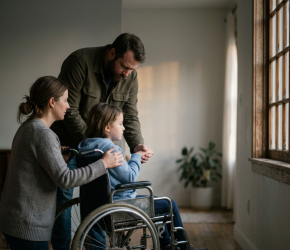
Now imagine caring for someone with a physical, developmental, or intellectual disability. Those trips don’t just double—they multiply.
The reality is that rural families are already at a disadvantage. Although roughly one in five Americans lives in a rural community, rural residents experience poorer health outcomes and have significantly less access to specialized healthcare than those living in urban areas. (Source: CDC Rural Health)

Healthcare Beyond Reach
In our region, pediatric healthcare often extends little beyond routine well-child visits. Pediatric mental health services are scarce, and the professionals who do serve our area are stretched thin trying to meet overwhelming demand.
If your child needs specialized care—a gastroenterologist, developmental pediatrician, pediatric cardiologist, dermatologist, or countless other specialists—the wait for an appointment can be months long. That’s often after months, or even years, of trying to obtain the referral in the first place.
According to the U.S. Health Resources and Services Administration (HRSA), more than 60% of federally designated primary care shortage areas are rural, affecting nearly 29 million people. HRSA estimates rural America needs nearly 5,000 additional primary care practitioners to eliminate those shortages.
Once an appointment is finally secured, families often drive an hour or more each way, turning what may be a thirty-minute visit into an all-day commitment. If additional testing is ordered or another specialist becomes involved, the burden only grows.
The same challenges exist for therapy services. Outside of schools, occupational, speech, and physical therapy providers are few and far between. Even within our schools, therapist shortages make it difficult for children to receive the services they need consistently.
When Help Exists Only on Paper
Many families caring for individuals with significant disabilities qualify for respite services, which are intended to give caregivers an opportunity to attend appointments, spend time with their other children, or simply recharge. Caring for a child with significant disabilities is a 24-hour-a-day, 365-day-a-year responsibility, and that responsibility doesn’t disappear as children become adults. In many cases, it becomes even more challenging because physical age and developmental age often do not align, and support needs become increasingly complex.
Unfortunately, qualifying for respite services and actually receiving them are two very different things.
My own son has been approved for respite services for more than thirteen years. We briefly had a provider, but that ended after I came home to find my three-year-old essentially alone while the caregiver slept on my couch after working an overnight shift elsewhere. Since then, we have not had another respite provider.
We’ve repeatedly been encouraged to “find someone in your own life” who can be trained and reimbursed to care for our son. If I had someone able and willing to do that, I wouldn’t need to be searching for respite services in the first place. We have even advertised to hire someone ourselves and received no responses. Today, we remain on a waiting list for a respite home that can provide care one day each month—and it’s located in Orchard Park.
Our experience is frustrating, but it isn’t unusual. National rural health organizations have repeatedly identified shortages of healthcare providers, behavioral health professionals, and direct support workers among the greatest barriers facing rural families who care for individuals with disabilities.

No Place to Belong
Healthcare isn’t the only area where rural families are left behind.
Children and adults with disabilities have very few opportunities to participate in recreational or social activities close to home. While there may occasionally be a sensory-friendly movie or community fishing derby, those isolated events are not substitutes for the experiences many other children take for granted.
There are few opportunities to join adaptive sports teams, music programs, clubs, dance classes, gymnastics, or other structured activities where individuals with disabilities can participate alongside supportive peers and instructors.
The problem isn’t a lack of interest from families. It’s a shortage of trained staff, limited funding, and too little awareness that these opportunities are needed. Even when programs exist farther away, many families simply cannot spend two or more hours traveling for a thirty- or sixty-minute activity. For some individuals with disabilities, the trip itself is so physically or emotionally exhausting that they arrive unable to fully enjoy the experience.
Rural Families Deserve Better
Living in a rural community should not mean accepting fewer healthcare options, fewer support services, fewer recreational opportunities, or fewer chances for individuals with disabilities to fully participate in their communities.
Families in rural areas should not have to choose between exhausting travel, endless waiting lists, or simply going without. Geography should never determine whether someone has access to quality healthcare, meaningful support services, or the opportunity to live a full and connected life.
For families like mine—and countless others across rural America—it too often does.
Sources
• Centers for Disease Control and Prevention (CDC), Rural Health
• U.S. Health Resources and Services Administration (HRSA), Health Professional Shortage Areas
• HRSA Rural Health Reports and Recommendations
Jamie Hulin is a Franklinville mother who understands the big picture and fine print when it comes to educating disabled children. She and her family have years of first hand experience and navigating the system in our state and region. You can reach her anytime, jlhulin@yahoo.com
Read the previous two articles from the Hulin’s in this four-part series below: