

“When my Grandmother croaked out that old rhyme in a scary voice, I shivered and broke out in gooseflesh”
A COLUMN By Kathryn Ross
I remember trapsing down a darkened street under a canopy of whispering maples. The only light came from tall lamp posts and the glow of a crescent moon. It was Halloween.
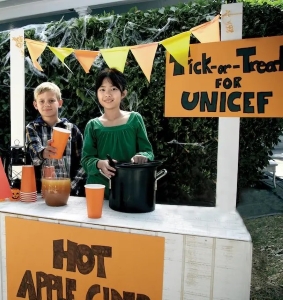
We carried pillowcases in one hand and small cardboard boxes in the other. We were disguised in our father’s military blouses or with our mother’s sheets over our heads. We might have worn a Zorro mask or a hot, hard, plastic mask with tiny eye holes. They did not stay in place long when we knocked on our neighbor’s doors and cried “Trick-or-Treat for UNICEF.”
In school they would give us small cardboard drink boxes which had UNICEF (United Nations International Children’s Emergency Fund) printed on the side. We were tasked to collect pennies, nickels and dimes for the kids who were starving in Africa. I think the money we collected went farther than did eating our string beans at the supper table.
According to UNICEF, “In 1950 kids first started collecting coins in milk cartons on Halloween night to support children in post–World War II Europe. It became a symbol of kids helping kids. For many, the little orange box was their first experience helping others. It is the longest-running youth engagement campaign in the United States. Trick-or-Treat for UNICEF has inspired generations of young Americans to come together for the world’s children. Since 1950 close to $200 million has been raised.” This year, the funds raised on Halloween night, by children, will go to help children in war-ravaged, earthquake damaged, Venezuela.
Halloween is traditionally a time when kids let loose, get into mischief, soap windows, and decorate neighborhoods with toilet paper. It is not just for kids. My mother would get in on the fun. She told me about growing up in Harrison Valley, PA and how one Halloween she and her friends put a car on top of a building. She also dressed up to embarrass my older sister. Pat was downtown with her friends one Halloween night when Mom showed up without her false teeth and dressed as a bathing beauty in blue tights and a sash. She just wanted to say “hello” to her daughter. Pat did not want anything to do with her.
My Halloween antics were not as mischievous as my mother’s.
When I was young, I celebrated not only Halloween night, but also Beggars Night.
The encyclopedia (You know, those heavy books with covers that are crammed with researched information.) says, “The origins of Beggars Night can be traced back to the ancient Christian tradition of All Hallows’ Eve and its connection to the Feast of All Saints. The practice of dressing up in costumes mirrors the idea of Christians recognizing the spiritual battle against darkness, a theme prevalent in Scripture. Today Beggars Night is a community tradition observed in some regions of the United States, around Halloween. On this night, children dressed in costumes go house-to-house asking for treats, echoing the sentiment of traditional trick-or-treating. This event allows children to engage with their neighbors, while often being framed around the themes of generosity and sharing.”
For me Beggars Night was just a convenient way of getting more candy. I had no idea I was participating in a religious tradition.
On Halloween this old rhyme plays in my mind:
‘Hark, hark, the dogs do bark.
Beggars are coming to town.
Some in rags and some in tags,
and one in a velvet gown.’
I first heard that old nursery rhyme from my Grandmother Martha, my mother’s mother. She was old when I met her, although probably not as old as I am now. My mother was the youngest of seven children and I am the youngest of the first generation of Martha’s grandchildren.
When my Grandmother croaked out that old rhyme in a scary voice, I shivered and broke out in gooseflesh. I never knew where it originated. So, I was surprised when I heard my college Literature Professor recite it in class one day.
It turns out, “Hark, Hark! The Dogs Do Bark” is an old English nursery rhyme. It ranges from the late 11th century to the early 18th century. Its earliest known printing was in Britain in 1788. In 1824, in ‘The Only True Mother Goose Melodies” it was published in America.
This Halloween, I’ve realized I am hearing my Grandmother’s, grandmother’s voice echoing through the centuries and that is not as spooky as it sounds.
Kathryn Ross is a Wellsville native and lifelong journalist, columnist, and mediaite. You can reach her anytime, kathr_2002@yahoo.com