
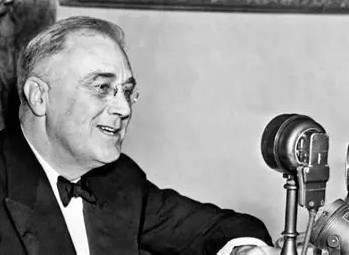
FDR used high tech, the radio, to reach the public in the early ‘30s
A OPINION By Kathryn Ross
I’ve sat around for most of the last two days procrastinating about doing housework. I don’t like doing housework, who does, but I have a sink full of dishes and a refrigerator to clean.
So, just what has kept me from doing housework – television. I really don’t watch TV. I stream programs on my laptop. Although I have a TV, I’ve been trying for months to increase the volume. I think my bout with Shingles limited my hearing in my right ear, although that doesn’t make much sense.
Anyway, what kept me occupied for two days was a documentary about Franklin Delano Roosevelt the man elected as president in 32, 36, 40 and 44. (Back then, the president elected in November, was not inaugurated until the following March.) I wanted to go back to a different time in American history and find out how the president handled economic problems he hadn’t created. See, I believe that there have always been tough times in this country; every few decades. What we’re going through now, is not all that different than what our parents, grandparents and great-grandparents endured. Some of these problems were created by politicians, but that wasn’t the case in FDR’s time.
Franklin Delano Roosevelt (January 30, 1882 – April 12, 1945), known as FDR, was the 32nd President of the United States serving from 1933 until his death in April 1945. He is the longest serving US President and the only one to have served more than two terms. His first two terms were centered on combating the Great Depression while his third and fourth terms focused on US involvement in World War II. A Democrat, Roosevelt served in the New York State Senate and as the 44th Governor of New York State.
From a distinguished family who also gave us Teddy Roosevelt, FDR was a career politician but a different kind of politician. Although he was wealthy and went to the best Ivy League schools, he was abundantly aware of the working man and the problems their families faced.

Unlike his firebrand fifth cousin, Teddy, FDR did not fight in World War I, although he had some pretty big sticks. He served as the PA Secretary of the Navy. He had wanted to hit the deck with his peers, but his President needed his diplomatic skills.
FDR contracted influenza after the war, but that is not what crippled him. In 1920 he became infected with the polio virus. He survived the deadly disease, but was paralyzed (handicapped) from the waist down for the rest of his life. While he was sidelined for a few years, getting back on his feet and learning to walk and stand (with an aide at his side) he was back in politics by the mid-20s. He ran for and served in various offices including the New York State Senate. He was getting the experience that would serve him well for what was to come.
In 1929 he was elected Governor of New York State. That October Wall Street had crashed creating the Great Depression which would last for much of the next decade. As Governor, Roosevelt declared a Bank Holiday and established a state employment commission and endorsed the idea of unemployment insurance.
He was persuaded to run in the ’32 Presidential election against Herbert Hoover and won. During his administrations Roosevelt introduced securities regulation, tariff reduction, farm relief, government-funded public works, and other government actions to address the Great Depression, Some of his major programs still impact our everyday lives -like the Securities and Exchange Commission, the National Labor Relations Act the Federal Deposit Insurance Corporation and Social Security.
In his memory the USS Franklin Delano Roosevelt was commissioned in 1945 and served until 1977. The Paris Metro built the Franklin Delano Roosevelt Sation in 1946, Westminster Abbey displays a stone memorial to Roosevelt. New York’s Welfare Island was renamed Roosevelt Island in 1973 and is where the Franklin Delano Roosevelt Four-Freedoms Park includes his bronze bust. In 2023 “FDR” a three-part miniseries chronicled his life, 80 years after his death and at a time when less than 120,000 World War II veterans who called him Commander In Chief were still living.
In my humble opinion, if any President should be commemorated with statues, buildings and arches for his service to the country and the world it should be FDR. Let’s carve his face on Mt. Rushmore.