

A Public Hearing will be held at 6pm, Common Council in public session at 7pm March 23
From the City of Hornell,
Common Council Meeting
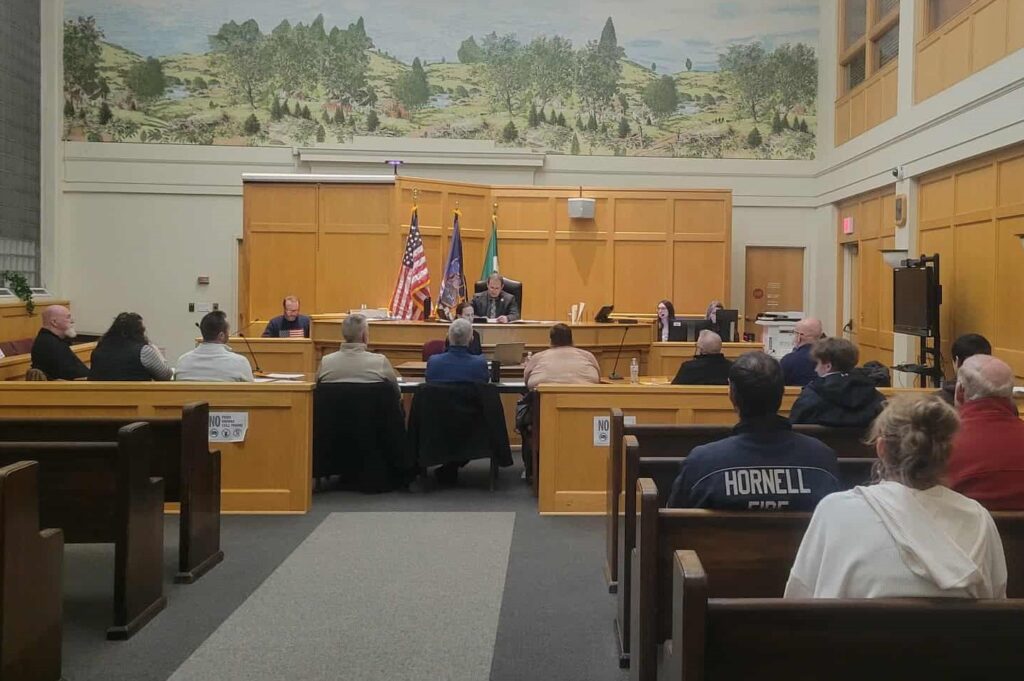
There will be a special meeting of the Hornell Common Council at 7 p.m. on Monday, March 23, 2026, in the Council Chambers of City Hall, at 82 Main Street.
There will be a Public Hearing at 6:00 pm, prior to the meeting to discuss proposed Local Law #1 of 2026-Tax Cap Override as well as a Public hearing for the General and Water Fund Budgets.
Your attendance is appreciated.

We asked City Mayor John Buckley to offer some context for the tax cap vote, a complicated municipal law imposed by NYS under Governor Andrew Cuomo:

“The tax cap is designed to control levy growth, but in practice it often reduces flexibility rather than costs. While that may sound like a subtle distinction, it has a very real impact on how municipalities like Hornell plan and deliver services.
It is important to remember the cap applies to the tax levy, not the tax rate. That distinction can create confusion, since a municipality can lower its tax rate and still exceed the cap depending on changes in assessed value and other factors.
There are also structural issues in how the cap is calculated. It does not account for expiring PILOT agreements, which can significantly shift the tax burden. We experienced that when the PILOT for the Wegmans/Walmart plaza expired years ago. Staying under the cap at that time would have required a tax rate reduction of more than three percent, which was not practical given the city’s obligations. Similarly, new development can increase service demands, but the cap may limit the municipality’s ability to raise the levy accordingly in the short term.
Another major factor is the inclusion of Business Improvement Districts in the tax cap formula. The Common Council does not control the BID’s budget, yet increases in that budget can push us over the cap even if the City’s own spending remains within it. Hornell Partners for Growth (the City’s BID) is not scheduled to adopt its budget until after the Common Council votes on the City budget. From a practical standpoint, it would be irresponsible not to override the cap when we don’t know what impact that separate budget will have on the calculation.
It is also important to note that the City budget relies on several funding streams from New York State. Because the State and the City share the same fiscal year, and because the State budget is often delayed, we have to project those revenues in advance. Those projections directly impact the tax cap calculation and add another layer of uncertainty.
At the same time, many of the costs we face are not fully within local control. Expenses such as pensions, health insurance, and state mandates often rise faster than the cap allows, creating ongoing pressure on the budget that cannot simply be reduced without affecting essential services.
While municipalities are held to this cap, the State itself is not subject to the same constraints, which raises broader questions about fairness.
At the end of the day, our priority is to deliver essential services, maintain infrastructure, and support our community in a fiscally responsible way. When the Council votes to override the cap, it is done to preserve flexibility and ensure we can meet those obligations without compromising the services and quality of life our residents expect.”