
Exploring the Western NY Wilds By Bob Confer
Many worm-like insects and arthropods like grubs, beetle larvae, centipedes, and millipedes aren’t the most popular creatures in the world. Seeing such crawlers can make a person’s skin crawl and even just hearing the word “maggot” can turn someone’s stomach.
Oddly, though, caterpillars get a free pass. Maybe it’s because everyone knows they turn into things more beautiful in adulthood — butterflies and moths. It’s more likely that they’re accepted because some caterpillars are far more colorful than plain white grubs.
But, can those varied hues temper what would otherwise be disconcerting sentiment towards crawlers if the observer discovered that they don’t turn into butterflies? Would the insects’ outcome later in life affect how you see them in their youth?
I bring that up because we are now in early fall, which is the season for sawfly larvae. They are out feeding as they prepare for a winter slumber that will see them as pre-pupae or pupae.
These little crawlers look just like caterpillars as they are possessed of magnificent color and design. But, they aren’t caterpillars. They don’t become moths. They transform into a flying insect that looks like and is related to wasps and bees.
A closer glance will find these baby insects to be anatomically different from caterpillars. Sawfly larvae have, like caterpillars, three pairs of true legs up front. Further back on their bodies, they have six or more pair of prolegs, which are “false legs”, fleshy little protrusions that help with forward movement.
Caterpillars, on the other hand, have just two to five pairs of prolegs. Also, sawfly larvae tend to be fleshy, lacking the hairs and spines many caterpillars have. And, baby sawflies tend to be small, many coming in at just under an inch in length, whereas caterpillars can be much longer.
That smallness should invite you, if you have a stomach for crawlers, to give them a closer look. Bend down and appreciate them or take a picture with your smartphone and zoom in.
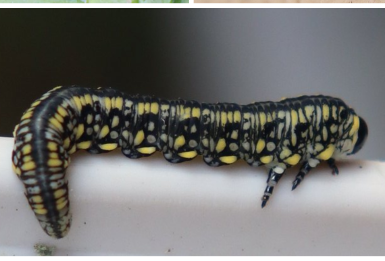
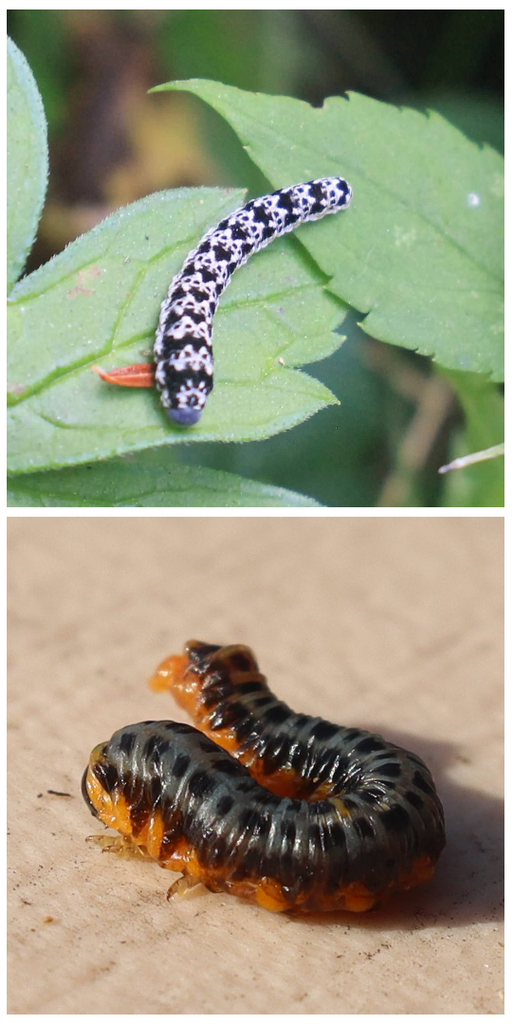
There are hundreds of species of sawflies in the USA and Canada. Let’s look at the three highlighted in the accompanying photos.
The first photo shows the introduced pine sawfly. It is incredibly beautiful with yellow and egg-shell dots on its black body. That beauty belies the threat this insect poses. The word “introduced” is in its name because it is just that – it hitched a ride on imports coming here from Europe. Being an invasive species, it creates problems for our native plants. This one loves eastern white pine and the autumnal generation of these larvae will dine on the youngest of needles, in many cases defoliating the tops of trees.
The next photo shows a brilliant black-and-white larva. This one has a scientific name of Tenthredo grandis. From what I can gather, it lacks a common name. This native insect is rather uncommon in New York because it is thought to eat just one specific plant – turtlehead. That wildflower has a stable population but it’s not the most abundant of late-summer, early-fall flowers, hence the small population of this sawfly.
The final photo shows the larva of the dogwood sawfly. It has a blue top and orange underside, with black dots also on top. This brightly hued creature feasts on the leaves of shrubs known as red osier dogwood. The resilient plants almost always survive any defoliation.
I’ll often tell you that you should never overlook the beauty of the smallest things we share this world with. There are amazing colors and patterns to be seen on beetles, bugs, and even the things that might be perceived as creepy crawlies. This fall, enjoy what Mother Nature offers and keep an eye out for youthful sawflies.
Exploring the Western NY Wilds is a regular nature series from the sponge-like mind of Bob Confer who has explored and educated himself on the WNY biosphere since he could walk. You can reach him and Bob@ConferPlastics.com